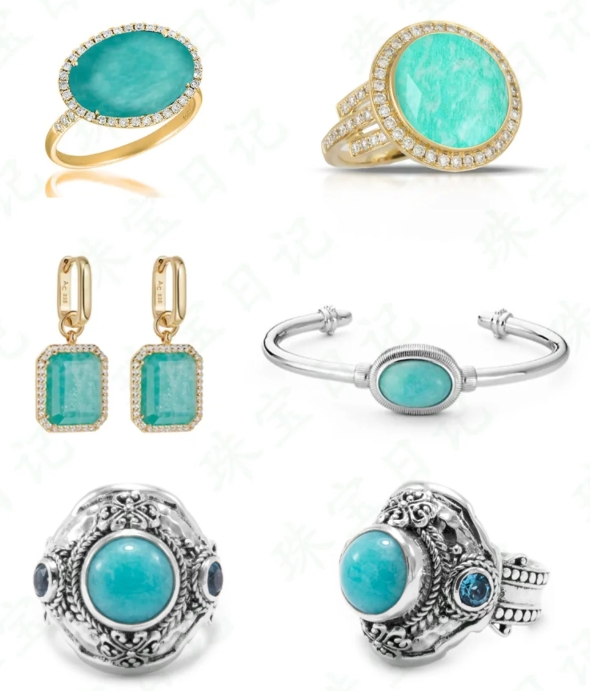
Amazonite is a blue-green variant of microplagioclase. It has distinctive features with green and white checkered color spots and flashes of light, caused by its unique and only bicrystalline structure, which is fundamentally different from emerald.
[Amazonite]
Category: feldspar group of potassium feldspar subgroup of microplagioclase feldspar species
Chemical formula: K[AlSi3O8], containing Rb and Cs
Color: Various shades of bright green or bright blue-green to light blue, common green and white checkerboard color spots
Luster: glassy
Transparency: translucent to opaque
Crystal system: Triclinic
Hardness: 6-6.5
Refractive index: 1.522-1.530
[Origin]
Representative places of origin: Mozambique, Peru, Brazil, USA, Canada.
Main Chinese origins: Xinjiang, Jiangsu, Gansu, Inner Mongolia, Yunnan and Sichuan.
[Similar stones].
Gemstone varieties similar to Amazonite mainly include chalcedony, beryl, turquoise, jadeite, dyed marble, silica malachite, synthetic spinel, glass, and plastic, which can be differentiated based on characteristics such as appearance features, refractive index, specific gravity, and internal inclusions.
[Value]
Amazonite can be used as a ring or carving. Those with a pure blue or emerald green color, bright texture, good transparency and little disintegration are of high quality. The emerald green Amazonite can be used as a substitute for jadeite.
[maintenance].
① Do not collide: feldspar has two groups of complete internal deconstruction, easy to break by external forces. Try to avoid colliding with hard objects or falling from high places when wearing and preserving.
② Keep away from friction: the hardness of feldspar is 6-6.5, please don't store it together with gemstones whose hardness is higher than that of celestite (e.g. diamonds, rubies, sapphires, crystals) in order to avoid scratches.

 Luxury Contrast Jewelry Display Stands | Elevate Your Jewellery with Premium Display Solutions
 Where Luxurious Brilliance Shines on Every Stage – The FANXI Deep Brown Microfiber Jewelry Display Set
 Elevating Jewellery’s Radiance: FANXI Premium Jewellery Display Props
 Elevate Your Jewels with Black Velvet: FANXI’s Premium Jewelry Display Set – Where Every Piece Shines Bright
