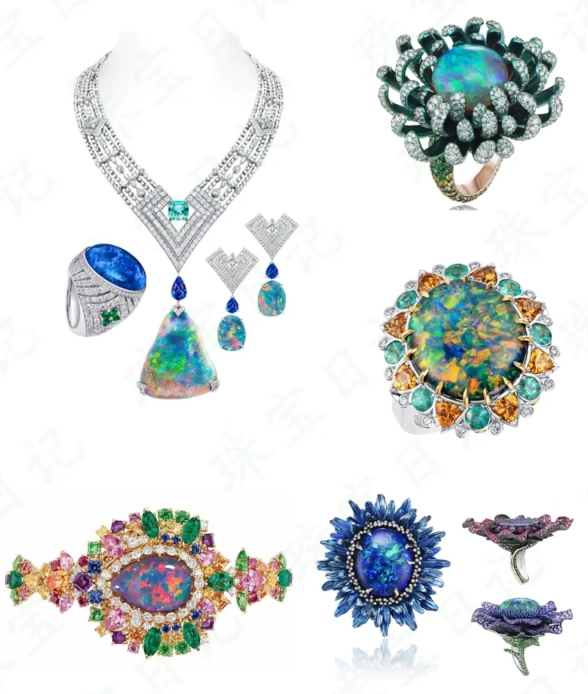
Black Opal refers to the black or gray body color and color change effect of the precious opal, is a valuable variety of Opal. Opal is the national stone of Australia and the birthstone of October. A colored opal with bright colors on darker body tones is called a black opal.
[Black Opal]
Chemical name: hydrated silica
Chemical formula: SiO2 *nH2O
Chemical Classification: Silicate
Luster: Glassy to resinous
Crystal system: amorphous
Fracture: shell-like fracture
Hardness: 5.5-6
Specific gravity: 1.250-2.30
Transparency: opaque - translucent
Refractive index: 1.370-1.470
CAUTION: Avoid excessive heat, solvents and ultrasonic cleaners.
[color-changing effect]
The special structure of gemstones to light interference, diffraction effect produces color, and the color with the light source or observation angle changes, this phenomenon is called color change. Usually, Opal has the color change effect, and colorful spots can be seen by turning the Opal under the light source. The more variegated colors and the more vivid they are, the higher their value, up to 7 variegated colors.
[Origin].
Black Opal is found in Australia, Peru, Ethiopia, Indonesia, Brazil, etc. It was discovered at Lightning Ridge in the 1880's, but its value was not recognized until it was first mined by Charlie Nettleton in 1903, who sold the first bag of black opal later that year.
[color].
Black Opal does not mean an opal that is black through and through; the body color of a black opal can be black or dark blue, dark gray, dark green, or brown. No matter which kind of opal, it contains many kinds of colors, red, blue, green, etc., can be said to be colorful and integrated.

 Luxury Contrast Jewelry Display Stands | Elevate Your Jewellery with Premium Display Solutions
 Where Luxurious Brilliance Shines on Every Stage – The FANXI Deep Brown Microfiber Jewelry Display Set
 Elevating Jewellery’s Radiance: FANXI Premium Jewellery Display Props
 Elevate Your Jewels with Black Velvet: FANXI’s Premium Jewelry Display Set – Where Every Piece Shines Bright
