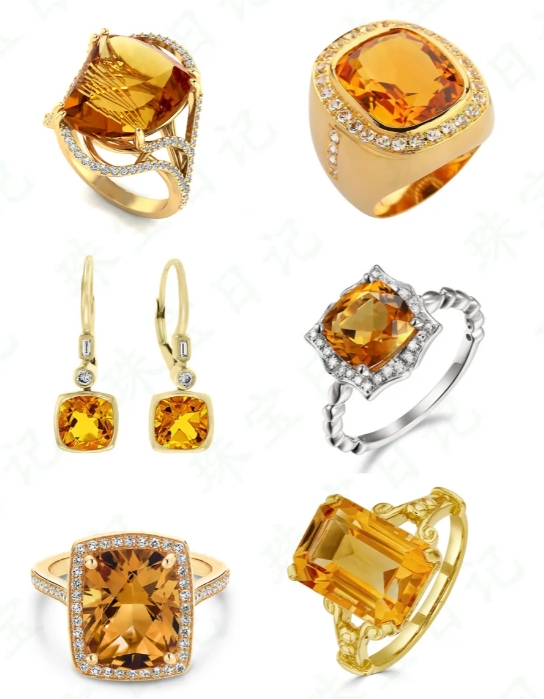
Citrine is derived from the French word 「citron」, meaning "lemon". Citrine belongs to the category of quartz and has a rich, mellow color that gives it a royal and prestigious look. The color is due to the presence of iron (Fe). It is easily confused with topaz.
[Citrine]
Main component: silicon dioxide
Other components: chromium, manganese, copper, iron
Crystal system: tripartite crystal system
Hardness: 7
Specific gravity: 2.60
Luster: glassy
Fracture: shell-like
Transparency: translucent-transparent
Refractive index: 1.544-1.553
Birefringence: 0.009
Color
①Light Yellow/Lemon Yellow Citrine (Yellow Citrine)
Light yellow or lemon yellow citrine, this color is light, more common in the market, so the price is relatively cheap.
② golden citrine (Golden Citrine)
As the name suggests, that is, with a golden yellow tone of citrine, the color is more intense than light yellow, noble.
③Madeira Citrine
The most popular citrine, the color ranges from golden orange, orange-red to deep orange, magnificent color similar to the Portuguese Madeira wine, is also the most expensive citrine.
④Palmeira Citrine
Translucent medium yellow to dark rich orange-yellow, in natural citrine is also very rare color, the price is higher than the golden citrine.
How to choose citrine?
①Color
The color of citrine is mostly yellow, ranging from pale yellow, orange to brownish orange, saturated yellow to reddish-orange and no brown hue citrine is more popular.
② clarity
Most citrines on the market do not have inclusions visible to the naked eye, if present, do not pick.
③Cut
Citrine is an easy to cut and shape gemstone, it can be cut into standard shapes and sizes, the most common cut shapes are round, oval, princess square, pear and emerald shaped, usually faceted to show off its good light properties.
④Carat Size
Citrine is available in a wide range of sizes and can be set in a variety of styles of jewelry. Overall, the value of citrine does not increase dramatically with carat size.

 The Ultimate Gift Guide for Watch Lovers and Jewelry Collectors
 5 Reasons to Meet the FANXI Team in Hong Kong This September
 Engineered for Presentation, Built for Protection
