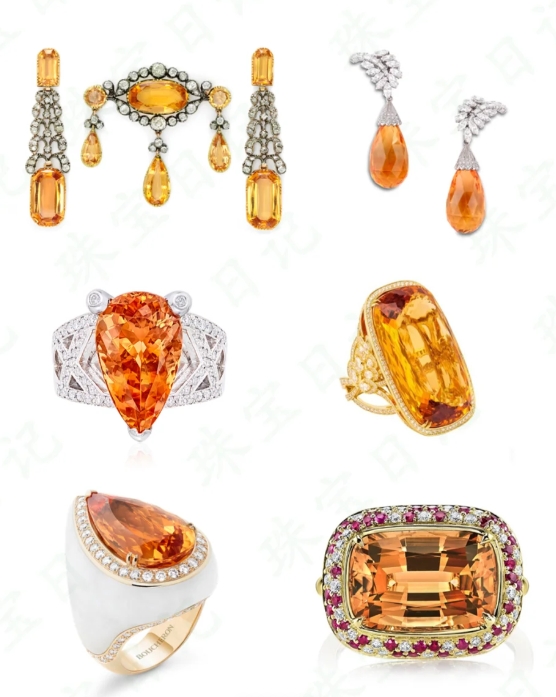
Distinguished from the similar-looking citrine topaz, Imperial Topaz is one of the world's most beautiful and rare gemstones, now produced only in the Brazilian state of Minas Gerais, and is the king of Brazil's proud gemstones, with a color and brilliance that rivals that of diamonds!
[Imperial Topaz]
Mineralogical name: Fluorinated aluminum silicate mineral
Chemical composition: Al2SiO4(F,OH)2
Mohs hardness: 8
Crystal system: rhombohedral crystal system
Luster: glassy
Transparency: transparent
Refractive index: 1.619-1.627
Dispersion: 0.014
[Variety].
Topaz comes in yellow, blue, green and colorless colors, but only reddish-brown or reddish-yellow topaz can be called imperial. Its extraordinary status can be glimpsed from its name. It is considered "imperial" in both aesthetic and collector value. A good quality Imperial Topaz is a deep orange-red in color, with a brilliant sparkle visible.
Color
Imperial Topaz has a color brilliance comparable to that of diamonds, and all the colors of the sun's rays can be found in Imperial Topaz, which varies in shades of fuchsia, pink, salmon, peach, cherry, and clear yellow.
✨ [History].
In ancient Europe, Imperial Topaz was the exclusive gemstone of the royal family or the Church, the nobility of colored gemstones, reserved for their use in custom-made jewelry, and little known to the common people. However, in the mid-18th century, along with diamonds, emperador topaz became popular in France and Spain, where it was set in ornate precious metals, and since then it has gained notoriety. To this day, major jewelry makers value the decorative qualities of topaz.
[Symbolism].
Topaz itself is known as the "Stone of Friendship", symbolizing friendship; while the Imperial Topaz symbolizes wealth and intelligence with its extraordinary quality and status. Often combined with precious metals and velvety fabrics to create luxurious jewelry, it is favored in everyday life because it is not very expensive. Imperial Topaz is considered in Europe as a protective gemstone to avoid bad luck and bring good fortune.
It is also used as a commemorative stone for the 23rd and 50th wedding anniversaries, and is a witness to the idea of "holding hands with one's son and growing old with him".

 Luxury Contrast Jewelry Display Stands | Elevate Your Jewellery with Premium Display Solutions
 Where Luxurious Brilliance Shines on Every Stage – The FANXI Deep Brown Microfiber Jewelry Display Set
 Elevating Jewellery’s Radiance: FANXI Premium Jewellery Display Props
 Elevate Your Jewels with Black Velvet: FANXI’s Premium Jewelry Display Set – Where Every Piece Shines Bright
